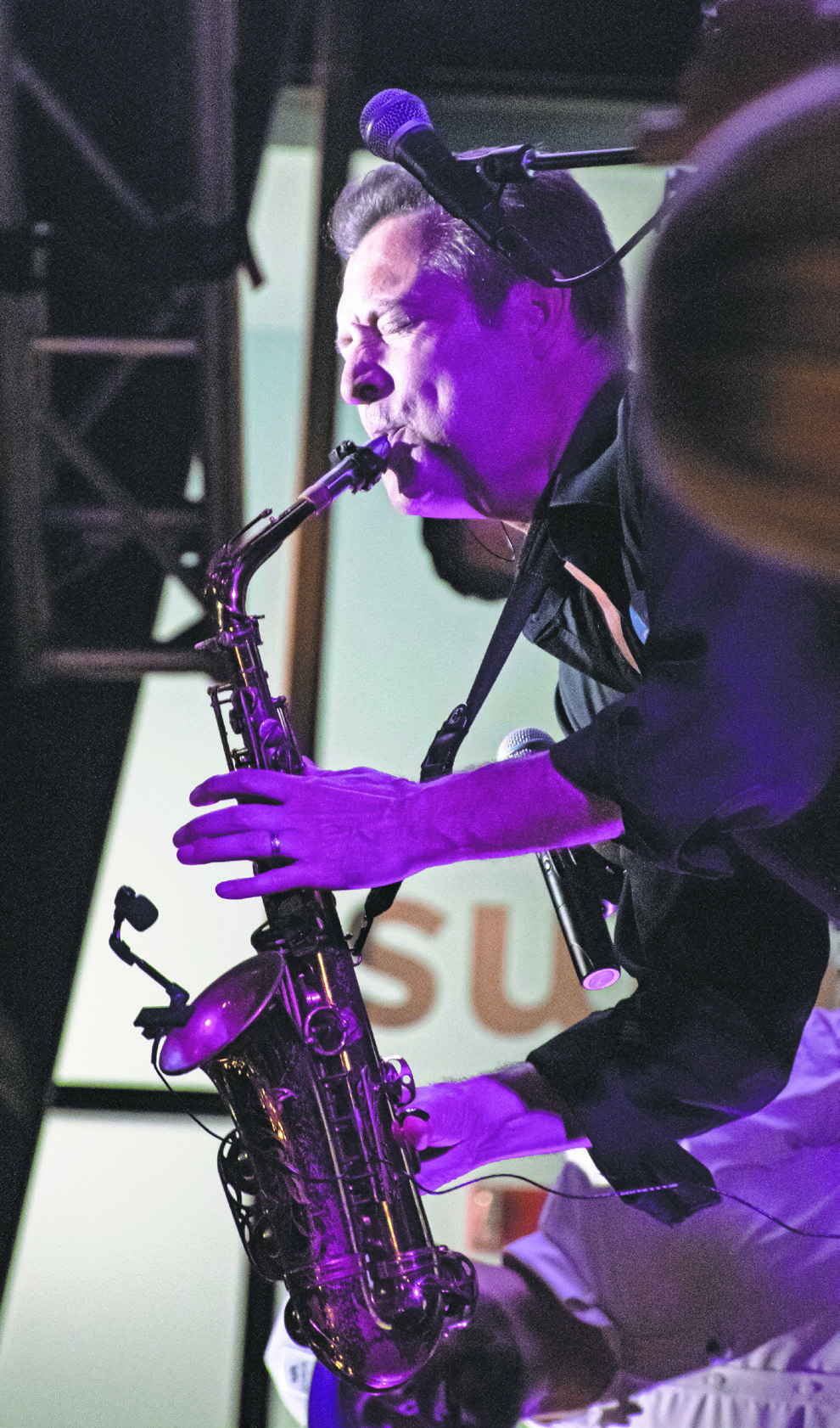
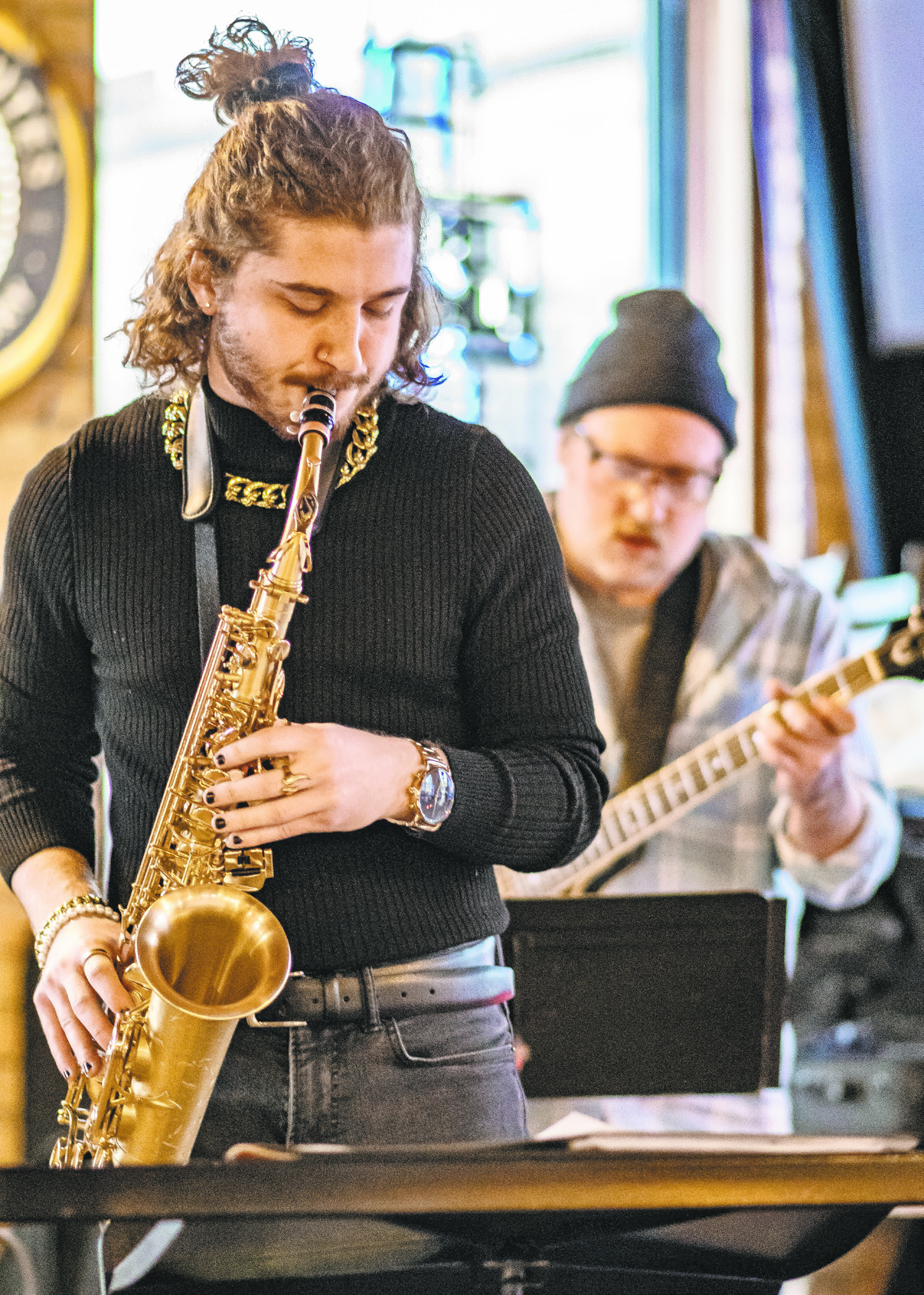
Prairie Public Radio will air a special jazz night at 9 p.m. Friday. The performance, a once-only gathering of local artists, was recorded live in Fargo. Pictured here are musicians Race Hoglund and Nick Gruber.


Rock ’n’ roll will fill the Fargodome. WE Fest is one of the largest country music festivals in the United States. But in Fargo, if you count popularity by the number of performances, just the number of times a live band appears in front of a live audience, neither rock nor country can hold a downbeat to jazz.
Jazz appears every week. It appears at the Sidestreet Grill, the Delta hotel, the Spirit Room. You can hear it at Broadway Square, the Rosewild lounge, the Sons of Norway, the Red River Market, and the Civic Center.
Not every place every week, of course. But the list is long and includes church parking lots as well as every high school and college in town.
On Nov. 4, at 9 p.m., it will fill the radio airwaves of the whole of North Dakota, too, when Prairie Public Radio broadcasts a special jazz night, a onceonly gathering of local artists, recorded live in Fargo.
The history of jazz in Fargo is long and deep. Once upon a time, there used to be a place downtown called the Crystal Ballroom (not to be confused with the current Crystal Ballroom at the Delta by Marriott), and Duke Ellington played there.
In fact, his recording “Duke Ellington at Fargo, 1940 Live” won the Grammy Award for Best Large Jazz Ensemble Album in 1980. The Crystal Ballroom does not exist anymore, but in the alley behind Rhombus Guys and Babb’s Coffeehouse, you can see an old Crystal Ballroom sign, and the Jeff Knight mural of Ellington at a piano.
Maynard Ferguson played in Fargo, as have artists like Nestor Torres and Phil Woods.
But big names are not the source of energy here. There are roughly 30 musicians who play consistently in town, rearranging themselves into small groups with new names every week, depending on the style they intend to play.
Concordia professor Russ Peterson sits at the center of the current Fargo Jazz scene.
“When I got here in 1997, there was a big band called The Jazz Arts Big Band,” he says. “I had read about them in Ohio. Jazz in Fargo was getting some national press. That group folded, but then a piano player named Simon Rowe moved to town. He was at MSUM.
He started weekly jazz at several places, just his trio. And this was not background music. This was intense, straightahead jazz played really well. And the audience was there.”
Jazz is all about performance, and every performance is a journey based on skilled improvisation.
A musician can play a standard like “Satin Doll” a hundred times, and every time will be intentionally different.
Every gig is unique.
That’s why the jazz audience goes out, then goes out again, to listen.
Jazz in Fargo is not just the old standards.
A lot of it is debut work by the local players.
“Improvisation is composition,” Peterson says. “It’s spontaneous composition. So every jazz player in town is a composer. You can’t not do it. I don’t know one jazz musician who doesn’t write their own stuff.”
Allen Carter’s big band started in what used to be called Studio 222 and played only his compositions. The Kicks Band, founded in 1975 and now run by Tim Johnson, has a recording project of all original music from Fargo including work by Allen Carter, Russ Peterson, Ralph Mutchler, Ed Christianson, Ed Schwind, and Ray Obiedo. Titled “Big Band Originals,” the album is scheduled to be released shortly after the band’s Nov. 19th concert.
Most jazz musicians in town are teachers, but others work for a silk screen company, UPS, as restaurant servers, accountants, a stay-at home dad. They play jazz, but fill in with visiting rock bands and play for the Fargo- Moorhead Symphony as well. The symphony just debuted a clarinet concerto Peterson wrote. Variety informs the jazz player’s imagination, which is what drives the improvisation.
“The jazz audience is an educated audience,” Peterson says, “listening for the new journey more than the established riff.
They don’t come out to hear the songs they know well, only the way they know them.
They come out for the foundations and then the exploration. They are along for the ride and appreciate it. I can take more chances.”
Local talent
Across town, Kathie Brekke started playing solo piano and singing at the Delta Hotel when it opened as a Ramada in 1998. Now Kathie Brekke and the 42nd Street Jazz Band includes bass and drums and brass, and a variety of others who sit in. Her music is bright and energetic. “Jazz night started in February of 2001,” she says. “This will be our 21st year. It’s the longest running jazz night in Fargo’s history.”
“We have people who grew up on jazz,” she says, speaking about the audience. “We have people who want intelligent dinner music.
The Delta is very much a listening room.”
A jazz band has a different relationship with the audience than most. It’s closer, more intimate, more responsive. “Since jazz is a listening thing,”
Brekke says, “you have to be able to run the room, to be able to sing a song that matches what’s going on right in front of you, to respond to the person who wants Charlie Parker and then to the person who loves a muted buzzy trumpet like Miles Davis, and then the group of 30-somethings who want to swing dance.”
“I remember when we had jazz nights three nights a week,” Brekke continues, “More than 20 different people playing every month.
The Jazz Arts Big Band was a really big deal.
Mary Marshall was phenomenal, probably the best jazz musician we’ve ever had. Then we had Allen Vizzutti and Wayne Bergeron, all of these players who were national names coming to Fargo and they would sit in with my band. As a young 30-something myself, I realized how cool it was to have this universal language called jazz. These guys knew the changes and we would play together without a rehearsal. That has been the biggest joy of my life.”
Bassist Max Johnk is one of the younger jazz artists in town. “I started playing in high school, rock and stuff. And I knew I wanted music as a career. I wanted to be a working musician,” he says. “I started to get deep into John Coltrane and Sonny Rollins.
And I became a fan of listening.”
There is a challenge, though. “We’re not Chicago,” Johnk says.
“We’re not New York or New Orleans or Kansas City. Jazz isn’t embedded in the cultural bones of this place. Jazz comes to us through the colleges.
The good news, however, is that it creates the space for someone like me to join the scene.”
Johnk plays more than jazz. His work is also directed toward indie and alternative music. And he is quick to point out that serious music fans of any genre can create a wonderful audience.
“They are appreciative,” he says.
“The best thing about jazz, for me,” he continues, “is when you’re playing a song, you’re playing with a common intention, you’re trying to create a common sound, but it’s flexible. Rather than being stuck with one person’s agenda or a pre-defined outcome, everyone on the bandstand has to listen and respond in the moment. If the bandstand is full of good listeners, even old songs can feel brand new. Improvised music rewards empathy and risk-taking. And the audience gets it.”
The jazz players in town gather in new combinations, sometimes based on who is leading, sometimes based on a theme, sometimes based on a new idea someone wants to try. The list includes the Max Johnk Trio, the BeBop Express, the Matt Patnode group, David Ferreira and Friends, the Monday Night Big Band, the Brecker Brothers Tribute Band, Jazz Avalanche, Russ Peterson and the Funk Commission, the Race Hoglund group and more. Russ Peterson publishes an email newsletter that lists who is performing where.
Recently, however, the whole community gathered for a superjam at the Sidestreet Grille and Pub, which was recorded for Prairie Public Radio. “Every player has their own set of fans,” Peterson said, so the upstairs room was packed. “Appreciative,”
Johnk said, smiling.
Two hours of jazz standards and original music, energetic and loud as well as moody and soft, the music ran the whole scope of Fargo jazz. All of it fresh and unique. The recording, soon to be broadcast over the entire Prairie Public Radio network, demonstrates the talent and energy of Fargo jazz.
“It’s the unrehearsed moments that are so powerful and what we love,” Brekke said.